
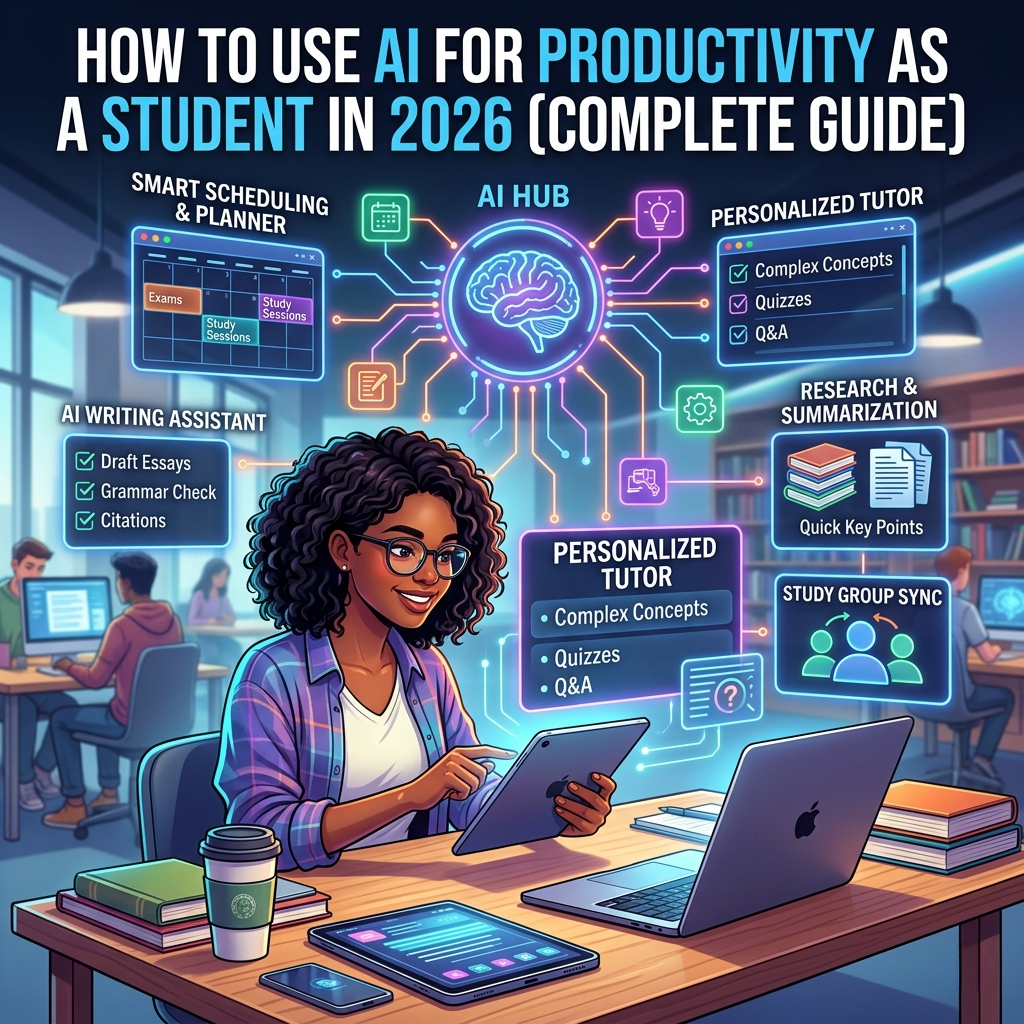
1. Why AI for Student Productivity Has Become Essential in 2026
Academic life has never been more demanding. Students today juggle multiple courses, deadlines, research papers, and the constant pressure to stay ahead in a competitive landscape. Fortunately, AI tools for student productivity have matured from novelty into genuine academic companions — tools that sharpen focus, reduce workload, and unlock personalised learning at scale.
This is not about shortcuts. The most effective students in 2026 use AI the way a professional athlete uses coaching software: to identify gaps, optimise routines, and improve consistently. AI does not replace critical thinking — it amplifies it.
| 92% of global students used at least one AI tool in 2025 (Digital Education Council) | 2× faster learning with AI tutors vs traditional classrooms (Harvard Physics Study, 2025) | 5.9 hrs saved per week on average by AI productivity tool users | 45% of Pakistani university students have used AI study tools (PSEB Survey, 2024) |
| Why This Matters for Pakistan With over 22 million students enrolled in secondary and higher education in Pakistan (Higher Education Commission, 2023), the demand for accessible, affordable learning tools is enormous. AI tools — many of which are free or low-cost — level the playing field significantly for students in Karachi, Lahore, Peshawar, and beyond — especially those preparing for MDCAT, ECAT, university exams, or professional certifications. |
Key Benefits of Using AI Study Tools
- Personalised learning paths — AI adapts to your learning pace and identifies weak areas
- Time management support — smart planners reduce scheduling friction and missed deadlines
- Writing and research assistance — AI writing assistants refine essays without replacing original thought
- Exam preparation — auto-generated quizzes, flashcards, and revision summaries
- 24/7 availability — a virtual study partner that never sleeps
2. Best AI Tools for Students in 2026: A Complete Breakdown
Below is an unbiased, fact-checked breakdown of the most effective AI productivity tools for students available in 2026. Tools are categorised by use case, not ranked by preference, because the right tool depends on your subject area and study style.
AI Writing Assistants
- Grammarly — Real-time grammar, clarity, and tone suggestions. Ideal for essays, emails, and research papers. Free basic tier available. One of the most widely used AI writing assistants for college students globally.
- QuillBot — Paraphrasing, summarising, and grammar checking in one platform. Especially useful for students who want to rewrite content while maintaining original meaning. Supports Pakistani academic writing styles. Free basic tier available.
AI Research & Learning Tools
- ChatGPT (OpenAI) — The most widely used conversational AI for students globally in 2026. Excellent for brainstorming, concept explanations, and essay outlining. Always verify facts from authoritative sources before using in academic work. Free basic / paid premium.
- Google Gemini — Deeply integrated with Google Workspace (Docs, Drive, Gmail). Available to students via Google for Education programmes. Free.
- Wolfram Alpha — Essential for science, engineering, and mathematics students. Provides step-by-step problem solving for calculus, physics, statistics, and more. A must-have for ECAT and advanced STEM preparation. Free.
- Khanmigo (Khan Academy) — A Socratic AI tutor that guides students to answers through questions rather than giving them directly. Builds critical thinking. Free via Khan Academy.
AI Productivity & Organisation Tools
- Notion AI — All-in-one workspace for notes, assignments, and project management. Notion AI can summarise lectures, generate study outlines, and manage deadlines. Works well on mobile — important for Pakistani students. Free plan available.
- Microsoft Copilot — Built into Microsoft 365 (Word, PowerPoint, Excel). Most Pakistani universities provide Microsoft 365 to enrolled students for free, making Copilot one of the most accessible free AI tools for students in Pakistan. Free via university.
- Otter.ai — AI-powered audio transcription. Records and transcribes lectures automatically. Highly useful for students who prefer typed notes and for those with hearing accessibility needs. Free limited tier.
AI Exam Preparation Tools
- Quizlet AI — Auto-generates flashcards and practice quizzes from uploaded notes or textbooks. Effective for students preparing for MDCAT, ECAT, and semester finals. Free basic tier.
- Anki (AI-enhanced) — Spaced-repetition flashcard system widely used by MBBS and pharmacy students in Pakistan for memorisation of complex terminology. Free.
Quick Comparison: Which Tool for Which Student?
| Tool | Best For | Free? | Mobile? | Pakistan? |
| ChatGPT | Writing, brainstorming, concept help | ✓ Basic | ✓ | ✓ |
| Grammarly | Essays, professional writing | ✓ Basic | ✓ | ✓ |
| Wolfram Alpha | Maths, physics, engineering | ✓ | ✓ | ✓ |
| Notion AI | Notes, project management | ✓ Free plan | ✓ | ✓ |
| MS Copilot | Office documents, presentations | ✓ via uni | ✓ | ✓ |
| Quizlet AI | Flashcards, self-testing | ✓ Basic | ✓ | ✓ |
| Otter.ai | Lecture transcription | ✓ Limited | ✓ | ✓ |
| QuillBot | Paraphrasing, summarising | ✓ Basic | ✓ | ✓ |
3. AI Study Tools for Students in Pakistan: Local Context
| Pakistan-Specific Insights AI adoption in education is growing rapidly across Pakistan. A 2024 survey by the Pakistan Software Export Board found that over 45% of university students had used at least one AI-powered tool for their studies — a figure projected to double by 2026. Research published in 2026 by Pakistani universities confirms that AI-based analytics significantly enhances academic performance when combined with digital literacy skills. Pakistan’s Higher Education Commission (HEC) is actively piloting AI-powered adaptive learning platforms across multiple universities. |
For students across Pakistan — whether enrolled in Matric/Intermediate boards, O/A Levels, university semesters, or preparing for professional entry tests — several considerations make AI tools particularly relevant:
- Bilingual support: Tools like Google Gemini and ChatGPT can explain difficult academic concepts in both English and Urdu, functioning as a bilingual study partner.
- Mobile-first access: Many students in Pakistan rely primarily on smartphones. Virtually all tools listed above have mobile apps optimised for lower-bandwidth connections.
- Cost accessibility: Free tiers on ChatGPT, Grammarly, Wolfram Alpha, and Quizlet ensure that cost is not a barrier to entry.
- Competitive exam prep: For MDCAT, ECAT, CSS, and entry tests, Wolfram Alpha and Quizlet AI are especially powerful for rapid concept revision and self-testing.
| Recommended Free Starter Stack for Pakistani Students Begin with this free combination: ChatGPT (concept help) + Wolfram Alpha (STEM problems) + Quizlet AI (flashcards) + Microsoft Copilot (university Microsoft 365). This covers research, problem-solving, exam prep, and document work — entirely free. |
4. How to Use AI Tools for Academic Success: Step-by-Step
Owning a tool does not mean knowing how to use it well. Study smarter with AI by following a structured approach. Here is a practical framework any student can adopt:
- Define your goal for each session. Before opening any AI tool, decide whether you need help understanding a concept, generating an outline, finding sources, or reviewing a draft. Goal-first use prevents passive scrolling and shallow interaction.
- Use AI to explain, not to answer. Instead of asking ‘Write my essay on climate change,’ ask ‘Explain the main arguments for and against carbon taxes in simple terms.’ Then write from your own understanding. This is how AI enhances — rather than replaces — learning.
- Always verify AI-generated information. AI models can produce inaccurate or outdated data. Cross-reference any factual claim with peer-reviewed sources, official university databases (e.g., HEC Digital Library), or reputable publications before including it in academic work.
- Use AI for time management, not just content. Tools like Notion AI and Microsoft Copilot can help you build weekly study schedules, track assignment deadlines, and break large projects into manageable tasks. This is where AI time management for students delivers its greatest benefit.
- Build a personalised AI toolkit — not a single-tool dependency. Different subjects benefit from different tools. Science students gain from Wolfram Alpha; writing-heavy subjects benefit from Grammarly; research-intensive disciplines gain from AI literature tools. Combine them intentionally.
- Practise prompt engineering. The quality of AI output depends directly on how well you phrase your request. Learning to write clear, specific, context-rich prompts is a skill that increasingly differentiates capable students in academic and professional settings.
| Pro Tip: Build Your AI Study Team Think of AI tools as a team, not a single solution. Assign each tool a role: ChatGPT is your tutor, Grammarly is your editor, Wolfram Alpha is your calculator, Notion AI is your planner, and Quizlet is your exam coach. Using each tool for its strength produces far better results than relying on one tool for everything. |
5. Academic Integrity & Ethical AI Use for Students
Using AI responsibly is not just a recommendation — it is an academic obligation. Universities globally, including institutions in Pakistan operating under HEC guidelines, are developing clear policies on AI use. Violating those policies carries serious academic consequences.
| Important: Check Your Institution’s AI Policy Policies on AI use vary significantly by institution, course, and assessment type. Always consult your university’s academic integrity policy before submitting AI-assisted work. When in doubt, ask your lecturer or academic advisor directly. |
Ethical Guidelines for AI-Assisted Academic Work
- Disclose AI use when required by your institution. Transparency is always the correct approach.
- Do not submit AI-generated text as your own original work without substantial revision, critical analysis, and personal contribution.
- Cite AI-generated content appropriately where permitted. Most major citation formats (APA, MLA, Harvard) now include guidance on AI citation.
- Never share confidential data — classmates’ information, unpublished research, institutional data — with public AI platforms.
- Develop your own skills. Use AI as a scaffold — something to help you build capability — not a crutch that replaces your engagement with course material.
The goal is to become a more effective learner and critical thinker, not to let AI do the work for you. Students who use AI as a genuine learning aid — rather than a shortcut — consistently report deeper subject mastery and stronger academic performance.
6. Frequently Asked Questions
What are the best free AI tools for students in Pakistan in 2026?
The best free options for Pakistani students are ChatGPT (free basic tier), Wolfram Alpha (free), Google Gemini (free), Microsoft Copilot (free via university Microsoft 365), and Quizlet AI (free basic plan). These cover concept learning, maths, research, document work, and exam preparation without any cost.
Is using AI tools considered cheating?
Not inherently — but it depends on your institution’s policy and how you use it. Using AI to understand concepts, generate outlines, or proofread your own writing is generally acceptable. Submitting AI-generated text as your own original work without disclosure or significant personal contribution is considered academic misconduct at most institutions. Always check your university’s specific guidelines.
Can AI tools help Pakistani students prepare for MDCAT and ECAT?
Wolfram Alpha is particularly effective for the maths and physics components of ECAT. Quizlet AI can auto-generate flashcards from syllabus content. ChatGPT can explain complex biology, chemistry, and physics concepts in simple language. Combined with official study materials and past papers, these tools can meaningfully support entry test preparation.
Do AI tools work without fast internet in Pakistan?
Most tools function on 3G/4G mobile data, though response times may vary. Notion AI and Quizlet have offline features for previously cached content. Wolfram Alpha is generally lightweight in data usage. For the best experience, use a Wi-Fi connection where available.
What is the future of AI in Pakistan’s education system?
Pakistan’s Higher Education Commission is actively integrating AI into educational policy and piloting adaptive learning platforms at the university level. Research published in 2026 confirms that AI-based predictive analytics significantly improves academic performance in Pakistani universities, especially when paired with digital literacy development. AI literacy is increasingly being incorporated into school and college curricula nationwide.
Final Thoughts: Study Smarter, Not Just Harder
The students who will thrive in 2026 and beyond are those who treat AI as a thought partner — a tool that sharpens their thinking, saves them time on routine tasks, and opens doors to deeper learning. They are not those who outsource their education to a chatbot.
Whether you are a university student in Karachi or a high schooler in a rural district preparing for board exams, the best AI tools for students in 2026 are largely free, mobile-accessible, and capable of delivering meaningful educational benefit. The barrier to entry has never been lower. The responsibility to use these tools wisely has never been higher.
Start small. Pick one tool. Use it consistently and critically. Build from there.
| About the Authors — AI Education Editors This guide was written and fact-checked by a team of education researchers and digital learning specialists with experience covering EdTech developments in South Asia and globally. All statistics cited are sourced from peer-reviewed research, government reports, and established EdTech publications current to March 2026. |