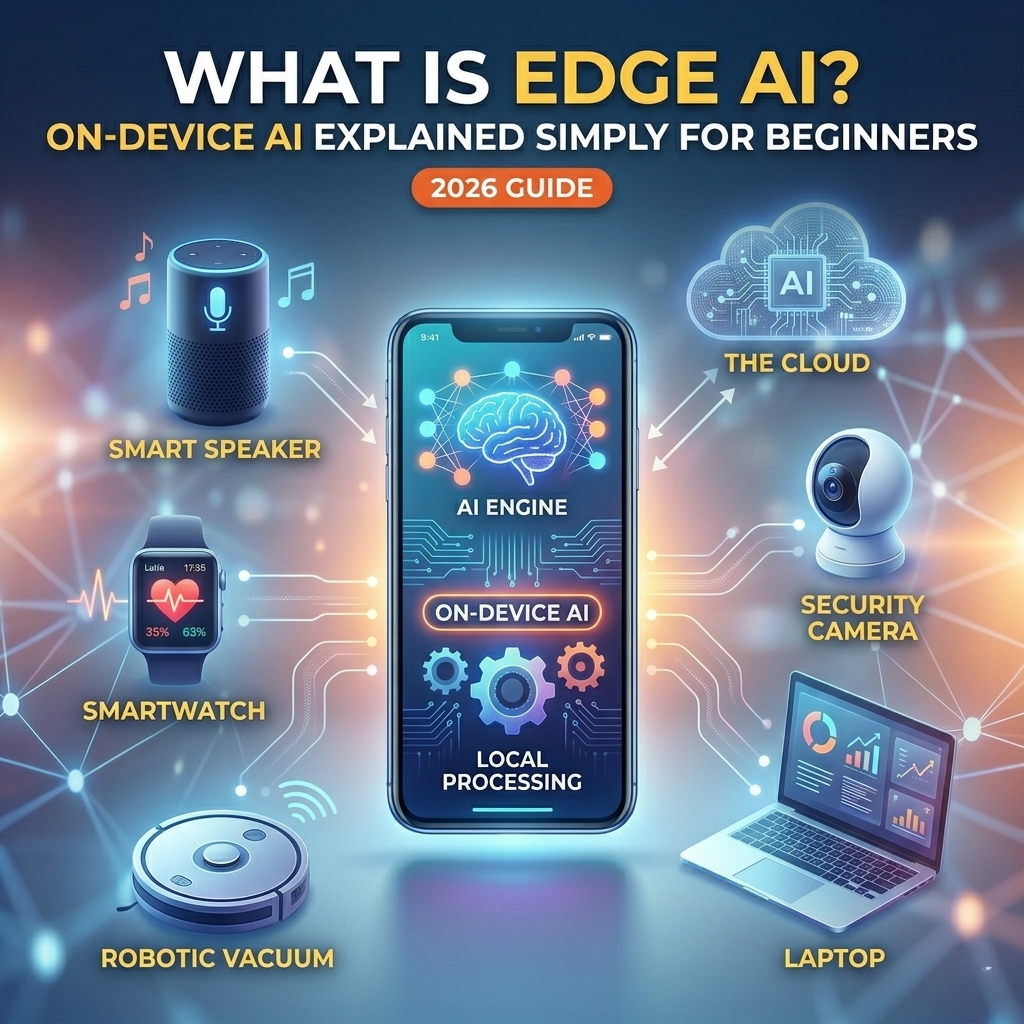
What Is Edge AI? A Simple Definition
Edge AI refers to artificial intelligence that runs directly on a local device — such as a smartphone, camera, sensor, or laptop — rather than on a remote cloud server. The word “edge” describes the outer boundary of a network: the place where data is actually created and used, close to the user.
In traditional (cloud-based) AI, your device sends data to a faraway data centre, the server runs the AI model, and sends back a result. With on-device AI, the entire process happens right on your device — no internet round-trip required.
Think of it this way: instead of asking a librarian in another city to find a book for you, Edge AI puts a mini-library right in your pocket.
How Does On-Device AI Work?
Running AI on a small device is no small feat. Here is how the technology makes it possible:
1. Specialised AI Chips (NPUs)
Modern devices now include dedicated Neural Processing Units (NPUs) — chips specifically designed to run AI tasks efficiently. Apple’s A-series chips, Qualcomm’s Snapdragon, and Google’s Tensor chips are well-known examples. These chips handle AI calculations faster and with far less battery drain than standard processors.
2. Lightweight AI Models
Large AI models used in data centres cannot fit on a phone. Engineers create compressed, optimised versions — sometimes called Small Language Models (SLMs) or TinyML models — that retain strong accuracy while requiring far less memory and power. Examples include Google’s Gemma 3 (as small as 270M parameters) and Meta’s Llama 3.2 (1B–3B parameters), both designed for efficient on-device use.
3. Local Inference
“Inference” is when an AI model makes a decision or prediction based on new data. In Edge AI, this inference process happens locally on the device, delivering results in milliseconds.
Edge AI vs. Cloud AI: What Is the Difference?
Understanding the difference between these two approaches is key to appreciating why Edge AI is generating so much attention in 2026.
| Feature | Cloud AI | Edge AI |
|---|---|---|
| Where AI runs | Remote data centre | On your device |
| Internet required? | Yes, always | No — works offline |
| Speed / Latency | Slower (depends on connection) | Very fast (milliseconds) |
| Data privacy | Data leaves your device | Data stays on device |
| Cost over time | Higher (server costs) | Lower (no bandwidth fees) |
| Best for | Complex tasks, large models | Real-time, privacy-sensitive tasks |
It is important to note that Edge AI and Cloud AI are not competitors — they are complementary. Most modern AI systems use a hybrid approach: edge devices handle real-time tasks locally, while the cloud manages training, updates, and large-scale analytics.
5 Key Benefits of Edge AI
1. Faster Responses (Low Latency)
When AI processes data locally, there is no waiting for information to travel to a data centre and back. This matters enormously in time-critical scenarios — a self-driving car detecting a pedestrian cannot afford a half-second cloud round-trip.
2. Stronger Privacy
With on-device AI, your personal data never leaves your smartphone or wearable. This is a major advantage for sensitive applications in healthcare, banking, and personal communications — an increasingly important concern in Pakistan and globally.
3. Works Without Internet
Edge AI functions reliably in areas with poor or no internet connectivity. In a country like Pakistan, where rural areas often face inconsistent broadband access, this benefit is especially practical for agricultural sensors, offline translation tools, and smart health devices.
4. Lower Costs
Every API call to a cloud AI service carries a cost. By shifting inference to the device, businesses can significantly reduce bandwidth and cloud infrastructure expenses over time.
5. Energy Efficiency
Modern NPUs are designed to deliver AI performance with minimal power consumption. This extends battery life and reduces the energy footprint of AI — an important consideration as global concerns about the environmental impact of large data centres continue to grow.
Real-World Applications of Edge AI in 2026
Edge AI is not a future concept — it is already embedded in many products people use every day:
- Smartphones: On-device voice assistants, real-time photo enhancement, live language translation, and face unlock — all run locally on your phone’s AI chip.
- Healthcare Wearables: Smartwatches that monitor heart rhythms, blood oxygen, and sleep patterns using local AI, without uploading your health data to external servers.
- Autonomous Vehicles: Self-driving and driver-assistance systems process camera, radar, and LiDAR data in real time on-board. Cloud latency would be dangerously slow.
- Smart Cameras & Security: AI-powered surveillance cameras that detect anomalies, count people, or identify unusual activity locally — reducing privacy risks associated with cloud-based video storage.
- Industrial & Manufacturing: Factories use Edge AI for predictive maintenance (detecting machine failures before they occur) and real-time quality control on production lines.
- Agriculture (Pakistan-relevant): Smart sensors in agricultural fields can monitor soil conditions, detect crop diseases, and provide automated irrigation alerts — operating without reliable internet connectivity.
- Retail: In-store kiosks and inventory systems powered by on-device generative AI that assist customers and manage stock without cloud dependency.
Edge AI Market: How Big Is It?
The numbers reflect a clear industry shift. According to Grand View Research, the global edge AI market was valued at approximately USD 24.91 billion in 2025 and is projected to reach around USD 118.69 billion by 2033, growing at a compound annual growth rate (CAGR) of approximately 21.7%. Industry analysts from IoT Analytics have described 2026 as an “inflection point” — the year when edge AI moves from early pilots to mainstream product portfolios across industries.
Major technology companies — including Apple, Qualcomm, Google, Microsoft, and MediaTek — have made substantial investments in on-device AI hardware and software. For Pakistan’s growing technology sector, this represents both an opportunity (local startups building AI applications that run offline) and a challenge (staying current with rapidly evolving hardware requirements).
Challenges and Limitations of Edge AI
A balanced view requires acknowledging the current limitations:
- Limited Model Complexity: On-device AI models are necessarily smaller and less powerful than their cloud counterparts. Tasks requiring deep reasoning or very large knowledge bases still perform better in the cloud.
- Hardware Constraints: Available RAM on mobile devices is often under 4GB after operating system overhead. This limits the size and architecture of AI models that can run locally.
- Deployment & Update Complexity: Managing AI model updates across thousands of devices — many in remote locations — is technically challenging and requires robust over-the-air (OTA) update infrastructure.
- Ecosystem Fragmentation: Different devices use different AI chips, operating systems, and frameworks, making it complex for developers to build applications that run consistently across all hardware.
- Security Risks: Edge devices can be physically accessed or tampered with, introducing security considerations that are different from centralised cloud environments.
Edge AI and Data Privacy: What You Should Know
One of the most frequently cited advantages of Edge AI is privacy. When AI processes data entirely on-device, sensitive information — medical readings, voice recordings, financial transactions, personal photographs — never leaves your hardware. This reduces the risk of data breaches, unauthorised surveillance, and misuse by third parties.
Globally, regulatory frameworks are beginning to reflect this reality. The EU AI Act, which became fully enforceable in 2026, requires high-risk AI systems to be auditable, traceable, and explainable — requirements that are shaping how edge AI systems are designed worldwide, including in markets that trade with or adopt standards from Europe.
For users in Pakistan, where personal data protection laws are still developing, on-device AI processing offers a practical layer of privacy protection that does not rely solely on legal frameworks.
The Future of Edge AI: What to Expect
Looking ahead, several developments are shaping where Edge AI is heading:
- Smaller, Smarter Models: The AI field has shifted toward compact, task-specific models. Industry research suggests that by 2027, organisations will use small, task-specific AI models three times more than large general-purpose models, according to Gartner projections cited by Dell Technologies.
- Hybrid AI Systems: Rather than choosing between edge and cloud, the dominant architecture will be hybrid — edge devices handle real-time, privacy-sensitive tasks; cloud systems manage training, complex reasoning, and long-term analytics.
- 6G Networks: Future 6G connectivity, operating at terahertz frequencies, promises to make edge-to-cloud collaboration even more seamless when connectivity is available.
- Federated Learning: This emerging technique allows AI models to improve over time by learning from data across many devices — without any individual’s data ever leaving their device.
- Agentic AI at the Edge: Autonomous AI agents that can make decisions, take actions, and self-correct are beginning to move from cloud-based systems to edge-resident deployments, enabling new levels of real-time automation.
Conclusion: Why Edge AI Matters to You
Edge AI represents a meaningful shift in how artificial intelligence interacts with everyday life. By moving intelligence directly onto devices — phones, cameras, sensors, vehicles — it delivers faster responses, stronger privacy, and greater reliability, even in areas without consistent internet access.
For beginners, the key takeaway is straightforward: on-device AI is not a replacement for cloud AI — it is a powerful complement. Together, they form the foundation of the next generation of intelligent technology.
Whether you are a technology enthusiast, a business decision-maker in Pakistan, or simply someone curious about the AI in your pocket, understanding Edge AI gives you a clearer picture of the technology shaping the world around you — right now, in 2026.
Quick FAQ: Edge AI for Beginners
Q: What is the difference between Edge AI and Cloud AI?
A: Edge AI processes data on the device itself; Cloud AI sends data to remote servers for processing. Edge AI is faster and more private; Cloud AI can handle more complex tasks.
Q: Does Edge AI require an internet connection?
A: No. One of its core advantages is that it functions without internet connectivity.
Q: Is Edge AI safe?
A: On-device processing reduces certain privacy risks because personal data does not travel over networks. However, physical device security and model security are important considerations.
Q: Can Edge AI replace Cloud AI?
A: Not entirely. Both approaches have strengths. The future lies in hybrid systems that use both intelligently.
Q: Is Edge AI relevant in Pakistan?
A: Yes. From agriculture and healthcare to mobile banking and smart cities, Edge AI has significant potential applications in Pakistan’s context, particularly where internet infrastructure is uneven.
Sources & Fact References: Grand View Research (2025 Edge AI market data); IoT Analytics (2026 inflection point report); Dell Technologies / Gartner (SLM projections); Edge AI and Vision Alliance (On-Device LLMs 2026); EU AI Act enforcement timeline (2026). All market figures cited are from industry research organisations and reflect published estimates, which may vary across sources.
Disclaimer: This article is written for informational and educational purposes. All facts have been verified against publicly available, credible industry sources as of March 2026. Market projections are estimates and subject to change.